

cc: Hon David Seymour; Hon Matt Doocey; Hon Casey Costello; Audrey Sonerson (DG Health); Dr Joe Bourne (CMO, MoH); Dr Dale Bramley (CE, Health NZ); Prof Dame Helen Stokes-Lampard (National CMO, Health NZ)
Re: NHS HORIZON study and implications for New Zealand policy on puberty blockers
Tēnā koe Minister Brown,
I am writing in support of the pause on puberty blocker prescribing and to highlight the significance of the NHS HORIZON study for New Zealand policy.
In the paper Use of puberty-blocking hormones for gender dysphoria in New Zealand: descriptive analysis and international comparisons [1] my co-authors and I found that New Zealand’s rate of puberty blocker prescribing was several times higher than the Netherlands and England through to 2020. Recent prescribing in New Zealand has fallen after an unexplained peak in 2021 but has remained at a relatively elevated level of more than 100 adolescents starting on puberty blockers each year (see updated chart). The question now is whether a return to these previous prescribing levels could ever be justified.
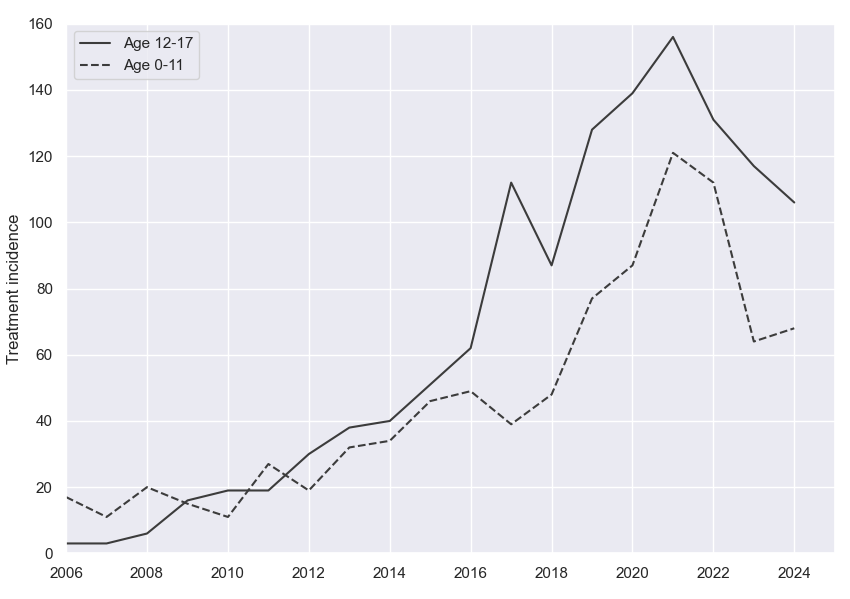
The government will reassess the pause at completion of the NHS PATHWAYS research programme, which includes a small trial [2] testing puberty blockers alongside psychosocial support on mental health and other measures. However, the more informative component of PATHWAYS is HORIZON [3]. The NHS is currently enrolling approximately 3,600 children and young people into HORIZON—a separate observational study following children and young people referred to gender services who will receive psychosocial support but not puberty blockers.
These are not children with mild concerns. They have been referred through multiple levels of NHS gatekeeping to specialist gender clinics. Many of these HORIZON participants would likely have received puberty blockers under the prescribing practices that existed in New Zealand until recently. The study’s primary outcome measure is mental health and wellbeing.
If these 3,600 young people show stable or improved mental health with psychosocial support alone, it would suggest previous over-prescribing in New Zealand and that our gender-distressed children and young people would likely have done equally well, if not better, without puberty blockers, but with psychosocial support that does not frame normal pubertal development as a medical crisis.
Is it plausible that the thousands of children and young people in the HORIZON study will deteriorate under psychosocial care alone because their pubertal development has not been blocked? The NHS study design reflects a clinical expectation that comprehensive psychosocial care can adequately support the vast majority of young people presenting to gender services. If the results bear this out, it would be very difficult to argue for a return to New Zealand’s previous high rates of prescribing.
Puberty is a time of emotional, cognitive, sexual, reproductive, and physical maturation. When less invasive alternatives exist, subjecting young people to the known risks of blocking normal pubertal development without reliable evidence of benefit is inconsistent with medical ethics. The government should clarify that developmentally informed psychotherapy [4], which explores the full picture of a young person’s distress, is both legal and responsible, as is now the first-line approach in the UK, Finland, and Sweden. The adolescents affected by this pause in puberty blocker prescribing deserve this care.
The Ministry of Health has called for more research into puberty blockers. New Zealand is well placed to contribute and could be world-leading. Our Integrated Data Infrastructure provides retrospective public health data that is among the most comprehensive in the world. A particular concern is bone density with a systematic evidence review indicating that it does not fully recover when the treatment is withdrawn [5]. There have been reports of former puberty suppressed patients with juvenile osteoporosis, chronic back pain, and a high rate of bone fractures in Sweden [6], the UK [7], and the USA [8]. I urge the government to commission an independent follow-up study of the adolescents already treated with puberty blockers in New Zealand. We owe it to them and their families to understand their outcomes.
Nāku noa, nā
Simon Tegg
References
[1] Paul, C., Tegg, S., & Donovan, S. (2024). Use of puberty-blocking hormones for gender dysphoria in New Zealand: Descriptive analysis and international comparisons. New Zealand Medical Journal, 137(1603), 79–88. https://doi.org/10.26635/6965.6587
[2] King’s College London. (n.d.). PATHWAYS TRIAL. King’s College London. Retrieved 29 November 2025, from https://www.kcl.ac.uk/research/pathways-trial
[3] King’s College London. (2025, July 31). PATHWAYS HORIZON. King’s College London. https://www.kcl.ac.uk/research/pathways-horizon
[4] Hutchinson, A. (2025). Cass informed psychotherapy for gender distressed youth. European Journal of Developmental Psychology, 1–19. https:/?doi.org/10.1080/17405629.2025.2540809
[5] Ludvigsson, J. F., Adolfsson, J., Höistad, M., Rydelius, P. -A., Kriström, B., & Landén, M. (2023). A systematic review of hormone treatment for children with gender dysphoria and recommendations for research. Acta Paediatrica, n/a(n/a). https://doi.org/10.1111/apa.16791
[6] Jemsby, C., Mattisson, K., & Lindahl, D. (2021, November 24). Mission Investigate reveals: Several children have been injured in transgender healthcare [Swedish: “Uppdrag granskningavslöjar: Flera barn har fått skador i transvården”]. SVT Nyheter. Updated February 23, 2022. https://www-svt-se.translate.goog/nyheter/granskning/ug/uppdrag-granskning-avslojar-flera-barn-har-fatt-skador-i-transvarden?_x_tr_sl=auto&_x_tr_tl=en&_x_tr_hl=en&_x_tr_pto=wapp
[7] Barnes, H. (2023). Time to Think: The inside story of the Collapse of the Tavistock’s Gender Service for Children. Swift Press.
[8] Twohey, M., & Jewett, C. (2022, November 14). They Paused Puberty, but Is There a Cost? The New York Times. https://archive.vn/LKdgB
Love your work, Simon Tegg
Excellent letter. Would it be worth sending to the leaders of Labour, Greens, and TPM and to their health spokespeople? I’d like to think they’d be open to reasoned argument supported by evidence - or am I being naive?